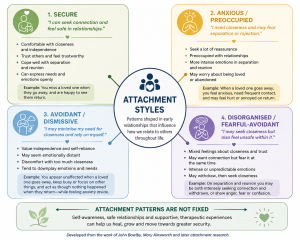
Summary of Attachment Styles
John Bowlby eminent in the field of child psychiatry he worked therapeutically with children in the 1950s-60s and is the pioneer an inventor of attachment theory (Bowlby, 1969; Bowlby, 1988).
John Bowlby emphasized the importance of attachment styles, comparing their necessity to life as vitamin D is to bone health. He studied babies' attachment to their parents, especially their mothers, in the USA. Mary Ainsworth expanded on Bowlby's work by creating the "Strange Situation" test to observe how babies, around a year old, reacted with their mothers in different scenarios (Ainsworth et al., 1978). Mary Ainsworth and John Bowlby could be viewed as the mother and father of attachment theory.
I find attachment theory hopeful because it shows that we can grow, build healthy relationships, and develop secure attachments, even if we began with an insecure attachment style. I think of my original attachment style as a kind of default mode that can reappear under stress, briefly slipping back into prior patterns. Self-awareness can help me recognise these moments, and myself or trusted loved ones compassionately pointing out when less helpful behaviours are activated would be helpful.
In his 2014 book The Body Keeps the Score, Bessel van der Kolk reflects on attachment theory and highlights Mary Ainsworth’s contribution through her extensive observations of infants and mothers, including the Strange Situation test (van der Kolk, 2014). Ainsworth observed that securely attached infants became distressed when their mother left the room but were delighted when she returned (Ainsworth et al., 1978). Van der Kolk notes that when primary caregivers are unresponsive or rejecting, children often respond in one of two ways: becoming persistently distressed and demanding, which reflects anxious-ambivalent attachment, or withdrawing passively, which reflects anxious-avoidant attachment (van der Kolk, 2014). These patterns also help us consider how attachment styles may influence the processing of, and recovery from, traumatic experiences but also with other challenging events or losses, loss of job ending of relationships and bereavement etc.
A brief summary of attachment styles as defined in from Mary Ainsworth’s Research
Secure Attachment
Infants with a secure attachment style became upset when their mothers left but were quickly comforted when they returned (Ainsworth et al., 1978). When we reflect on this attachment noting the babies were distress on separation and soothed on parents return, and apply this to adults in a secure relationship, we can feel or express how we might miss our loved one is going on a trip and will miss them and then happy to see them return.
Anxious-Ambivalent Insecure Attachment
These infants stayed distressed for longer and took more time to settle. They showed protest behaviours, such as clinging to their mothers and scanning the room (Ainsworth et al., 1978). In adult relationships, using the example of a loved one going on a trip, this attachment pattern may appear as heightened anxiety, a stronger need for frequent contact while they are away, and feelings of annoyance or hurt when they return (Bartholomew and Horowitz, 1991).
Anxious-Avoidant Insecure Attachment
These infants seemed calm and continued playing, but their raised heart rates suggested concealed distress. They also avoided eye contact. This pattern may suggest they had stopped expecting their attachment needs to be met and had begun to feel undeserving of care. In adult relationships, using the example of a loved one going on a trip, the person may appear unaffected by the separation while experiencing anxiety internally. When reunited, they may act as though nothing has happened, even though the absence was felt (Bartholomew and Horowitz, 1991).
Disorganised Insecure Attachment
These infants showed intense distress through behaviours such as hitting, biting, and moving between seeking closeness and pushing others away. They often needed considerable reassurance and could shift between withdrawal and anger (Main and Solomon, 1990). To consider this attachment style in adults on separation we might notice both intense feelings and withdrawal on both separation and when reunited (Bartholomew and Horowitz, 1991).
This brief overview can help us understand attachment styles and attachment-seeking behaviours with greater compassion. In his work with couples, John Gottman describes these moments in The Relationship Cure as “bids” for connection—attempts to feel assured that a loved one is emotionally available (Gottman and DeClaire, 2001). I view attachment theory as hopeful, compassionate, and open to growth and change. For this reason, I feel it can be painful when attachment language is used dismissively to describe someone’s needs.
Mary Ainsworth’s research significantly expanded understanding of attachment theory and attachment styles (Ainsworth et al., 1978). Her work later informed the adult attachment styles recognised today: secure, anxious-preoccupied insecure, dismissive-avoidant insecure, and fearful-avoidant, also known as disorganised or unresolved insecure attachment (Bartholomew and Horowitz, 1991).
Attachment theory helps us understand how attachment-seeking behaviours first seen in infancy can continue into adulthood in more complex forms (Bowlby, 1969; Bartholomew and Horowitz, 1991). For example, a partner who checks a loved one’s phone messages or feels preoccupied with the relationship may be showing anxious-preoccupied attachment behaviours. Many other examples show how early attachment patterns can appear in adult relationships.
Attachment styles, or inner working models of attachment, help us understand how we relate to others and seek to have our needs met (Bowlby, 1969). Encouragingly, attachment theory suggests that through therapy, strong bonds, and positive relationships—whether with friends, partners, or supportive colleagues—a person can move towards earned secure attachment. This matters because human beings naturally long to love and be loved.
John Bowlby once considered calling his work the “theory of love,” reflecting its central focus. He hoped others would build on his ideas, and over time, attachment theory has continued to evolve and deepen our understanding of human relationships.
References
Ainsworth, M.D.S., Blehar, M.C., Waters, E. and Wall, S. (1978) Patterns of Attachment: A Psychological Study of the Strange Situation. Hillsdale, NJ: Lawrence Erlbaum Associates.
Bartholomew, K. and Horowitz, L.M. (1991) ‘Attachment styles among young adults: A test of a four-category model’, Journal of Personality and Social Psychology, 61(2), pp. 226–244.
Bowlby, J. (1969) Attachment and Loss. Volume 1: Attachment. London: Hogarth Press.
Bowlby, J. (1988) A Secure Base: Clinical Applications of Attachment Theory. London: Routledge.
Gottman, J.M. and DeClaire, J. (2001) The Relationship Cure: A Five-Step Guide to Strengthening Your Marriage, Family, and Friendships. New York: Crown Publishers.
Main, M. and Solomon, J. (1990) ‘Procedures for identifying infants as disorganized/disoriented during the Ainsworth Strange Situation’, in Greenberg, M.T., Cicchetti, D. and Cummings, E.M. (eds.) Attachment in the Preschool Years: Theory, Research, and Intervention. Chicago: University of Chicago Press, pp. 121–160.
van der Kolk, B.A. (2014) The Body Keeps the Score: Brain, Mind, and Body in the Healing of Trauma. New York: Viking.