
Hypervigilance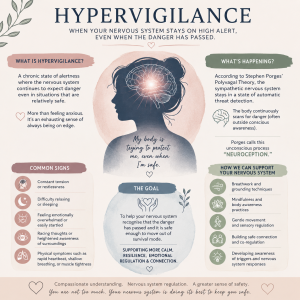
Hypervigilance can be understood as a chronic state of alertness or readiness, where the nervous system continues to expect danger even in situations that are relatively safe. It is more than simply “feeling anxious.” Many people describe it as an exhausting sense of being constantly on edge, unable to fully relax, with the body acting as though there is still a threat that requires a fight, flight, or protective response.
According to Stephen Porges, creator of Polyvagal Theory, hypervigilance is not simply “being overly alert.” Instead, the nervous system — particularly the sympathetic branch — remains in a state of automatic threat detection. The body continuously scans for danger, often outside conscious awareness, because it does not fully experience a sense of safety. Porges refers to this unconscious process of detecting danger or safety as neuroception.
When the nervous system becomes stuck in this protective state, people may experience symptoms such as:
- Constant tension or restlessness
- Difficulty relaxing or sleeping
- Feeling emotionally overwhelmed or easily startled
- Racing thoughts or heightened awareness of surroundings
- Physical symptoms such as rapid heartbeat, shallow breathing, or muscle tightness
The aim of my work is to help clients develop strategies that support regulation of the nervous system and gently calm the fight-or-flight response. Encouraging parasympathetic nervous system responses — the part of the nervous system associated with rest, connection, and recovery — clients can begin to experience a greater sense of safety within their body and environment.
This may include approaches such as:
- Breathwork and grounding techniques
- Mindfulness and body awareness practices
- Gentle movement and sensory regulation
- Building safe connection and co-regulation
- Developing awareness of triggers and nervous system responses
To help the client compassionately understand what is going on within the body, recognising that the danger has passed and that it is safe enough to move out of survival mode. Over time, this can support greater calm, resilience, emotional regulation, and a renewed sense of safety and connection.