
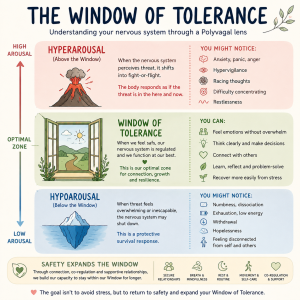
Understanding the Window of Tolerance Through a Polyvagal Lens
What Is the Window of Tolerance?
The Window of Tolerance model helps us recognise our optimal zone of functioning, where our emotions are regulated, our thinking is clear, and we can remain present while responding effectively to life's challenges and demands.
The term Window of Tolerance was originally developed by Dr Dan Siegel in 1999 in his book The Developing Mind. The concept aligns closely with Dr Stephen Porges' Polyvagal Theory.
Within our Window of Tolerance, we are more likely to:
- Feel emotions without becoming overwhelmed.
- Think rationally and make decisions.
- Connect with others.
- Learn, reflect, and problem-solve.
- Recover more easily from stress.
Polyvagal Theory and the Window of Tolerance
Dr Stephen Porges first introduced Polyvagal Theory in 1994.
According to Porges, the autonomic nervous system continuously scans for signs of safety or danger through an unconscious process he calls neuroception.
When we perceive safety, we are more likely to remain within our Window of Tolerance and access our:
- Social engagement system.
- Capacity for connection.
- Curiosity and creativity.
- Emotional regulation.
When the nervous system perceives threat, we may move outside the window.
Hyperarousal: Above the Window
When the nervous system shifts into a fight-or-flight state, we may experience:
- Anxiety
- Panic
- Anger
- Hypervigilance
- Racing thoughts
- Difficulty concentrating
- Restlessness
The body responds as if the threat is happening in the here and now, becoming mobilised for protection rather than connection.
Hypoarousal: Below the Window
When a perceived threat feels overwhelming or inescapable, the nervous system may move into a shutdown state characterised by:
- Numbness
- Dissociation
- Exhaustion
- Withdrawal
- Hopelessness
- Reduced energy
- Feeling disconnected from ourselves and others
From a Polyvagal perspective, this reflects a protective survival response rather than a personal failure.
Safety Expands the Window
One of the most important insights from Polyvagal Theory is that regulation occurs through experiences of safety.
Factors that can help widen a person's Window of Tolerance include:
- Secure relationships
- Feeling understood and accepted
- Predictable routines
- Mindfulness practices
- Breathwork
- Adequate sleep
- Physical movement
- Therapy and co-regulation with others
Co-Regulation Matters
Porges highlights that people regulate best through connection. Supportive relationships can help calm the nervous system and bring us back into our Window of Tolerance.
Examples of co-regulation include:
- A warm, soothing voice
- Compassionate listening
- Eye contact
- Safe and appropriate touch
- Being with someone who feels emotionally available and attuned
Key Takeaway
The Window of Tolerance helps us understand our responses with greater compassion. When the nervous system experiences safety in the present moment, we are better able to stay adaptable, connected, and emotionally regulated.
From a Polyvagal perspective, healing involves increasing our capacity for safety, connection, and co-regulation so that life's challenges feel less overwhelming and more manageable.